| |
|
 | |
| Online Flora of the Maltese Islands by Stephen Mifsud |
|
| |
|
|
 |  |  |  |
| External Links: |
|
Brassica rapa subsp. sylvestris (Wild turnip) |

Brassica rapa subsp. sylvestris (BRASSICACEAE.)
Images for this profile are taken from the Maltese Islands after year 2000.
Website launch: Oct-2002
Taxonomic update: Aug-2026
Code update: Jul-2026 |
|
| Nomenclature |
Species name : | Brassica rapa subsp. sylvestris (L.) Lam. & Janchen | Authority : | Carl von Linne, Sweden, (1707 - 1778) ;
Jean Baptiste A. P. de Monnet de Lamarck, France, (1744 - 1829);
Erwin Emil Alfred Janchen, Austria, (1882 - 1970) | Synonyms :
(basionym or principal syn.) |
|
Plant Family : | Brassicaceae Juss. (= Cruciferae )
(Mustard or Cress Family) | English name(s) : | Wild turnip, Bargeman's cabbage | Maltese name(s) : | Liftija | Status for Malta : | Indigenous. Present on the Maltese islands before man | Name Derivation : |
Brassica: Old name used for cabbages by Pliny (23 - 79 AD). (Latin origin); 2. Cabbage (Latin).
rapa subsp. sylvestris: (); 2. Turnip (Latin); Sylvestris means wild (Latin).
| Remarks : | - |
|
| Morphology and structure |
PLANT STRUCTURE: |
Character | Growth Form | Branching | Surface |
Description | | | |
General
Picture |  | 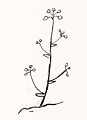 | 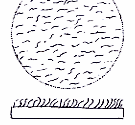 |
|
LEAVES: |
Character | Arrangement | Attachment | Venation |
Description | | | |
General
Picture | 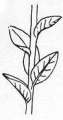 | 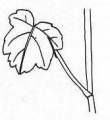 | 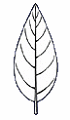 |
| |
Character | Leaf Shape | Leaf Margin | Remarks |
Description | | | |
General
Picture | 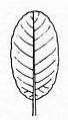 |  |  |
|
FLOWERS: |
Character | Colour | Basic Flower Type | No. of Petals | No. of Sepals |
Description | Bright Yellow | | 4 | 4 |
General
Picture | |  |  | |
| |
Character | Inflorescence | Description | Ovary | Stamens |
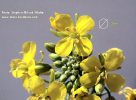
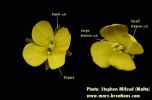
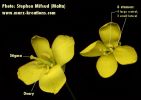
Description | | Flower consists of 4 oval, non-overlapping yellow petals arranged diagonally to each other, 6 stamens and a central pistil with swollen stigma. | | |
General
Picture |  | | 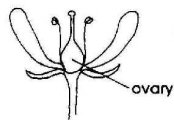 |  |
| |
Character | Scent | Average Flower Size | Pollen Colour | Other Notes |
Description | YES Faint sweet smell can sometimes be detected. | 12-14mm | Yellow | - |
|
SEEDS: |
Character | No. Per Fruit | Shape | Size | Colour |
Description | 25-35 | Globular Spherical shape, like a small bead. | 2-3mm | Dark greyish-brown colour (Sometimes, seeds have few pale specs). |
General
Picture | | | | |
|
FRUIT AND OTHER BOTANICAL DATA: |
Character | Fruit Type | Colour of Fruit | Subterranean Parts | Other Notes |
Description | | Green Turns light brown when fruit is ripe. | | - |
General
Picture |  | | 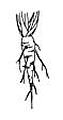 | |
|
|
| Plant description and characters | |
Life Cycle: | Annual. |
Growth Form: | Therophyte (annual plants, herbaceous, die after fruiting/seeding stage) |
Habitat: | Weedy places in fields, wasteland and sometimes in traffic islands and gardens. |
Frequency: | Common |
Localities in Malta: | Common in uncropped fields such as at Buskett, Mtarfa, Mistra and Ghajn Tuffieha to mention a few examples. |
Plant Height: | 30-60cm. |
| Nov-Apr |
Protection in Malta: | Not legally protected till the last update of this website (22/Aug/2025) |
Red List 1989: | Not listed in the Red Data Book of the Maltese Islands |
Poison: | |
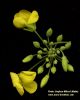
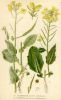
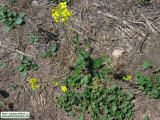
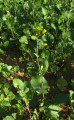
The plant consist of an erect stem up to 60 cm long with many sub-branching stems which continues to a terminal raceme inflorescence. The stem has some white/grey bristly hair along and the base gets tougher and a reddish-brown colour.
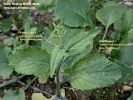
The young and adult leaves have different shapes. The basal adult leaves are stalked, ovoid with an irregularly serrated outline, while the young cauline leaves are smaller, sessile with basal auricles embracing the stem, less serrated outline, and are more elongated. 
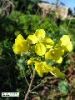
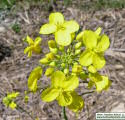
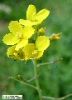
Flowers are made up of 4 diagonally arranged yellow petals, with 6 tetradynamous stamens (which means 4 central stamens with long filaments, plus 2 lateral and shorter) and a central superior green ovary with a single style and swollen stigma. The flower also has 4 green sepals which are spread out horizontally (perpendicular to stem axis)
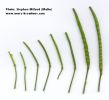
The fruit are found in stacks below the infloresences. They are stalked elongated pods called siliqua which become the seed pods of the plant. The siliqua can reach up to 50mm in length, has a pointed beak and its body is slightly bulging with the seeds inside. When the seeds are mature, the siliqua splits up open with a sudden twist of the outside walls and so expels the seeds inside at a further distance. A translucent central wall remains after dispersion. The small seeds are quite spherical in shape, and brown in colour.
|
|
| Information, uses and other details |
Personal observations
Dispersion
Dispersion of seeds is by sudden outwards twisting of the 2 outer walls (valves) forming the siliqua [SM]
Confusion in Maltese names
This plant is usually found growing with another white flowered Crucifer - the Diplotaxis erucoides (White wall rocket) Usually the white species grows more abundantly. The flower and plant morphology are quite similar, except the flower colour. The white species is called "gargir abjad" (white 'gargir'). There is another yellow-flowered crucifer species called "gargir isfar" (yellow 'gargir') which its species name is Diplotaxis tenuifolia. One could easy mistake the Maltese names when seeing the two populations of the yellow B. rapa silvestris mixed with the white D. erucoides growing close together and assume that both are gargir, one is white (gargir abjad) and the other is yellow (gargir isfar). B. rapa subsp silvestris is called "liftija" in Maltese and should not be mixed with "gargir isfar". [SM].
Comparison with Diplotaxis tenuifolia
In Malta there is another Cruciferae plant which is very similar to the Wild Turnip and more abundant. This is called the Perennial Wall Rocket - Diplotaxis tenuifolia). The perennial wall rocket can be easily mistaken for the Wild Turnip at first glance because the yellow flowers and slender fruit pods are very similar. The main differences are the leaves, size of the plant, size of the flower and sepals as indicated in the table below: [SM]
| Feature |
Brassica rapa subsp. silvestris |
Diplotaxis tenuifolia |
| Leaves |
Large, ovoid, serrated and hairy. Furthermore, young leaves have base lobes which embrace the stem |
Smaller, deeply dented, elongated, glabrous, no embracing lobes |
| Sepals |
Few mm below flower, long, perpendicular to stem |
Small, cup shaped near to flower |
| Flower Size |
13mm average |
slightly larger, 16mm average |
| Apical beak of seed pod |
Long |
Very short |
Not much information has been found about this particular plant species. If you can supply further info to be included in this profile, please do not hesitate to email us pr by using the form found at the botom of this page. Full reference credits will be given accordingly. Thank you for your support!
|
|
| Links & Further literature
(0 papers) |

Google Web |

Google Images |

Google Scholar |

Research Gate |

Wikipedia |

JSTOR |
GBIF |

Med Checklist |
Cat. of Life |

EoL |

IPNI |

World Flora Online |
Plants of the World Online |

Vienna Virt. Herb. |
RBGE Herbarium |
KEW Herbarium |
MNHN |

Garden Database |

IUCN |

TROPICOS |
Kindly Email if there are papers and publications about local
studies or information about this species to be included in the list above.
|
|

Sales and Donations

|
 |
Sales of seeds of wild plant from Malta: Seeds of selected wild plant species may be available for academic studies, research purposes, or personal use. Please note that not all species can be supplied or exported. Availability is subject to seasonal seed production, stock levels, and applicable regulations, including Maltese legislation and CITES requirements where relevant. Protected and endemic species cannot be sold (at least without the relevant environmental permits).
How it works: First, submit a quotation request by completing the Online Quotation Form (link provided on the right side of this table). Once your request has been reviewed, you will receive confirmation regarding seed availability, export eligibility (where applicable), pricing, and any transport charges. Payments are accepted by Revolut, bank transfer (IBAN), or PayPal only; credit and debit card payments are not accepted.
Please note that local orders are currently not being accepted. Seek Maltese nurseries and NGOs for local orders.
|
Online Quotation (Seeds)
|
 |
Buy Images: Purchase photographs from this extensive online collection of Maltese flora by Stephen Mifsud. Images are available at reasonable prices, with rates varying according to image size and resolution. Your purchase helps support the maintenance and development of this website. When placing an order, please note the image code displayed beneath each photograph on the corresponding species page, as this is required when completing the online order form. Images are normally supplied under a license agreement, with copyright retained by the author; however, the sale of copyright for exceptional images may be considered on request.
|
Online Purchase (Images)
|
 |
Support this ad-free website Kindly consider to support this website by giving a small donation which will help to cover some expenses needed to pay the webserver and domains, maintain the website without any adverts, upgrading the code, including more wild plants and photos, and adding further data amongst other developments. You can use the links on the right for direct donations to this website by PayPal or Revolut. Even a 5 or 10 Eur donation is appreciated. Remember this website was ad*free since its launch back in 2002 and has served as an environmental educational tool for over 20 years.
|
💙 Donate by PayPal
💳 Donate by Revolut
|
|
| Contribute Information or Report Errors |
Use this form to submit additional information about this species or to report any inaccuracies on this webpage.
If the information you provide is sourced from a book, journal, website, or any other publication, rather then your own information or experience, then please include the relevant reference or web address whenever possible. Your email address will be used solely for internal communication and will not be shared. We greatly appreciate reports of: taxonomic updates; species misidentifications; incorrect or outdated information, broken links, technical website issues, or any additional information specific to the plant in this webpage.
Your contributions help to improve the accuracy and quality of this website. Thank you! Fill any of the three sections (A/B/C) below: .
|
|
|
|
Webpage is copyright of Stephen Mifsud / www.MaltaWildPlants.com - (2002-2026)
| | |